







Hiring teams love to say they want “the best person,” then turn around and demand that the role be filled by Friday.
That tension feels familiar in every org: one side worries a slow process loses top talent, the other worries a rushed decision turns into a costly mismatch six months later.
And the market adds chaos.
Greenhouse’s Workforce & Hiring Report paints a messy picture: only 7% of candidates feel the market favors them, yet 72% say the job they applied for ended up different from what was offered.
Translation: confidence is low, trust is fragile, and misalignment shows up early.
So what should HR prioritize?
In this piece, we’ll give you a practical decision framework to choose the right trade.
No hand-wavy “it depends,” just clear calls you can actually use.
Hiring Faster vs Hiring Better: Defining the Core Metrics
First, let’s look at the two key metrics that define hiring effectiveness.
https://youtube.com/shorts/YiHdQZCZNW8?si=JaNRgxlgNgBfU3To
What is the Quality of Hire?
Quality of hire measures the real value a new employee brings after joining the team.
Sounds simple, yet every role defines “quality” differently.
A sales hire may succeed through quota attainment and strong sales-cycle discipline, while an engineer creates value through reliable delivery, clean code, and smooth collaboration across teams.
In customer success, retention rates and client feedback often tell the bigger story.
That’s why this metric gets tricky:
-
Performance takes time to evaluate.
-
Managers care about different outcomes.
-
Culture contribution rarely fits neatly into a spreadsheet.
Great hiring usually reveals itself months later, once the person starts shaping team results in a meaningful way.
What is the Speed of Hire?
Speed of hire shows how quickly a company moves candidates through the hiring process, from first touch to final decision.
It sits close to two useful metrics:
-
Time to hire: which usually tracks the period from candidate entry to accepted offer, and
-
Time to fill: which starts when the role opens and ends once someone accepts.
SmartRecruiters’ benchmark report puts global median hiring time at 38 days, which gives HR a helpful reality check.
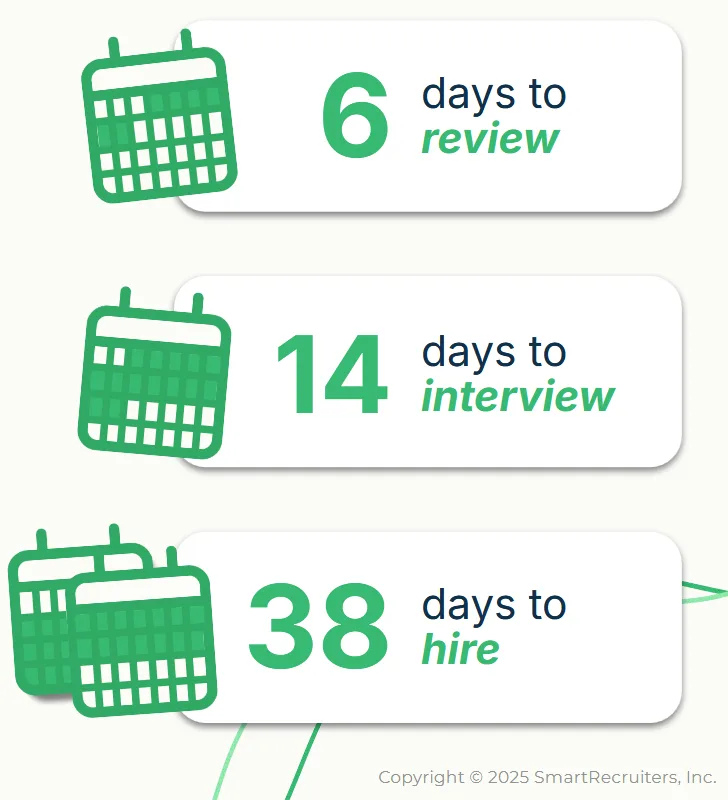
Source: SmartRecruiters
The interesting part: Speed has little to do with rushing people.
Most delays come from messy scorecards, slow interview feedback, endless interview rounds, scheduling chaos, or compensation discussions arriving far too late in the process.
Once the metrics are clear, a bigger question starts taking shape: which one should HR prioritize first?
Let’s start with the first one.
Why Quality of Hire Usually Deserves Priority
Quality of hire usually deserves greater attention because it sits much closer to real business outcomes.
AIHR connects quality of hire directly to the HR value chain: stronger hiring decisions shape stronger HR outcomes, which then influence organizational performance.
The hidden costs of speed-first hiring tend to appear later:
-
weak ramp-up and slower productivity
-
higher early attrition
-
repeated backfilling cycles
-
frustrated managers losing confidence in recruiting
-
lower team morale after a poor fit joins
-
disappointed candidates who entered the role with oversold expectations
In fact, the U.S. Department of Labor estimates that a bad hire can cost at least 30% of that employee’s first-year earnings, before accounting for morale and productivity losses.
In other words, speed may close the vacancy, but quality decides whether that hire actually solves the problem.
But of course, even the strongest hiring standards lose value when the process moves too slowly.
Why Speed of Hire Still Matters
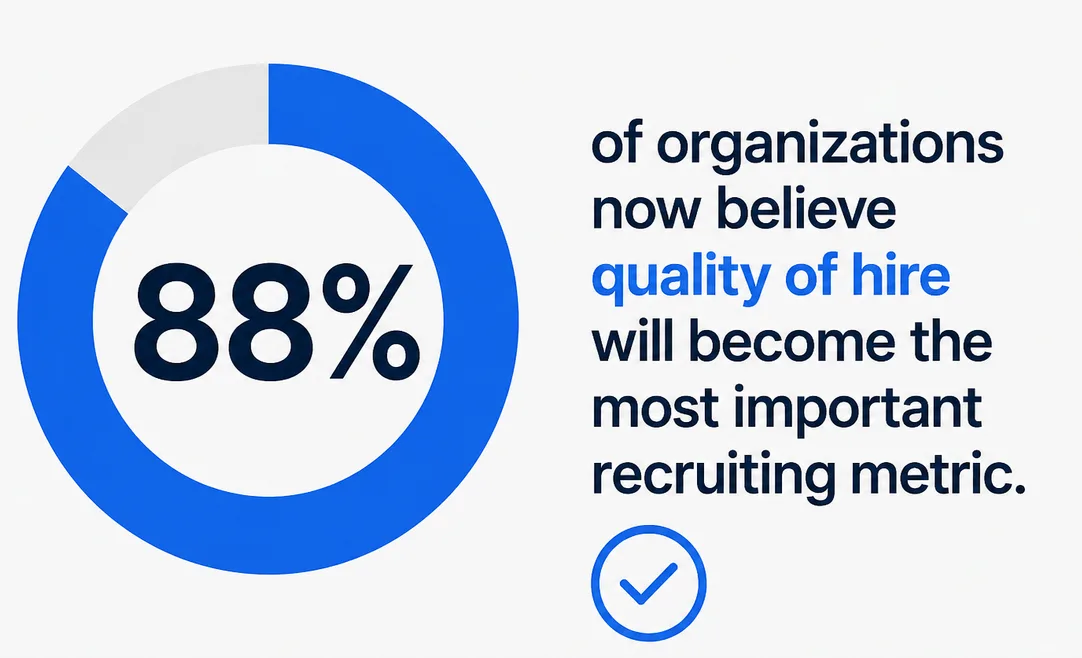
Although AIHR research we referenced earlier shows that 88% of organizations now believe quality of hire will become the most important recruiting metric, speed still plays a major role in hiring success.
Speed shapes candidate experience, offer acceptance, workforce planning, and day to day execution, especially when teams run lean and every open seat creates drag.
Greenhouse’s report adds extra pressure: candidates already face uncertainty, low trust, unclear roles, and AI-fueled application overload.
So a slow process with vague updates can quietly damage employer perception and push people toward faster, clearer offers.
In that sense, speed becomes part of quality when it improves clarity and responsiveness through timely communication, feedback, and fewer dead zones.
The real problem is uncertainty, because it drains confidence on both sides.
And that’s exactly where hiring conversations often become too narrow.
When HR Should Prioritize Quality Over Speed
Now let’s get more specific.
HR should prioritize quality over speed when the hiring decision carries serious business risk.
Some roles simply deserve more signal, more stakeholder alignment, and stronger evidence.
The goal is to add rigor where the cost of a weak decision would hurt the team, the customer, or the company.
|
Prioritize quality when... |
Why it matters |
|
The role has high business impact |
Executive, leadership, and senior strategy hires influence direction, priorities, and team performance. |
|
The cost of a bad hire is high |
Finance, legal, security, and compliance roles can create expensive errors fast. |
|
The role requires scarce expertise |
Senior engineering, AI, data, or niche technical roles need stronger skill validation. |
|
The hire represents the company externally |
Enterprise sales, customer success, and partnerships roles shape trust with key accounts. |
|
The team has faced early turnover |
A slower, deeper process can reveal expectation gaps before they repeat. |
|
Trust, safety, employee engagement, or culture fit is central |
People managers and sensitive roles need judgment, maturity, and alignment. |
|
The company is hiring for long-term capability |
Strategic hires should strengthen the business beyond today’s workload. |
Still, some hiring scenarios benefit far more from momentum than deeper refinement.
When HR Should Prioritize Speed Over Quality Refinement
Let’s look at the other side of the equation.
HR should prioritize speed over endless quality refinement when the process already has enough evidence to make a confident decision.
This does not mean lowering the bar.
It means removing extra friction once the team has clear proof that the candidate can do the job well.
|
Prioritize speed when... |
Why it matters |
|
The role is high-volume or repeatable |
Support, operations, retail, and junior sales roles often follow clear success patterns. |
|
The requirements are clear and trainable |
When skills can be taught fast, waiting for a “perfect” profile can create needless delay. |
|
The team has reliable assessment criteria |
Scorecards, structured interviews, and work samples help teams decide with confidence. |
|
The market is highly competitive |
Solid candidates may accept another offer while your team adds extra steps. |
|
The role causes immediate operational pain |
Long vacancies can slow delivery, overload teams, or hurt customer response times. Some organizations use interim executive search firms to address leadership gaps more quickly. |
|
The candidate pool moves quickly |
Fast-moving markets reward clear timelines and quick feedback. |
|
Vacancy cost outweighs perfection |
Sometimes a good hire now creates more value than chasing an ideal profile for weeks. |
But rather than treating these metrics as opposites, smart teams build hiring systems that connect them.
The Best Answer: Build a Balanced Hiring Scorecard
The answer to the quality versus speed debate is simple: stop choosing sides and build a balanced hiring scorecard.
HR should design a metric architecture that tracks how hiring decisions perform across three dimensions: performance impact, process efficiency, and candidate experience.
A balanced scorecard could include:
-
Quality metrics: performance after 6-12 months, retention, hiring manager satisfaction, ramp-up speed
-
Speed metrics: time to hire, time to fill, stage-by-stage delays
-
Experience metrics: candidate feedback, offer acceptance rate, clarity of role expectations
These three dimensions influence each other in practice.
A process can be rigorous, but if it becomes too rigid or time-consuming, it starts damaging the very outcomes it is meant to protect: 60% of candidates abandon job applications when the process feels too rigid or time-consuming.
This approach shifts the conversation from “Which metric wins?” to “Where is friction hurting results?”
-
When speed drops, you investigate process bottlenecks.
-
When quality drops, you review assessment rigor.
-
When experience weakens, you examine communication gaps.
Best hiring teams treat metrics as a system, because long-term results depend on how those signals work together.
But how does this balance actually work in practice? Let’s explore that next.
How to Improve Speed Without Sacrificing Quality
Today’s hiring market creates more noise than ever.
According to the Greenhouse study we mentioned at the very beginning, 45% of candidates use AI to prepare for interviews, 22% use bots to apply automatically, and 28% admit to using AI-generated fake work samples.
That changes the game completely.
Faster hiring now depends on better evidence, more accurate evaluation, and cleaner decision-making.
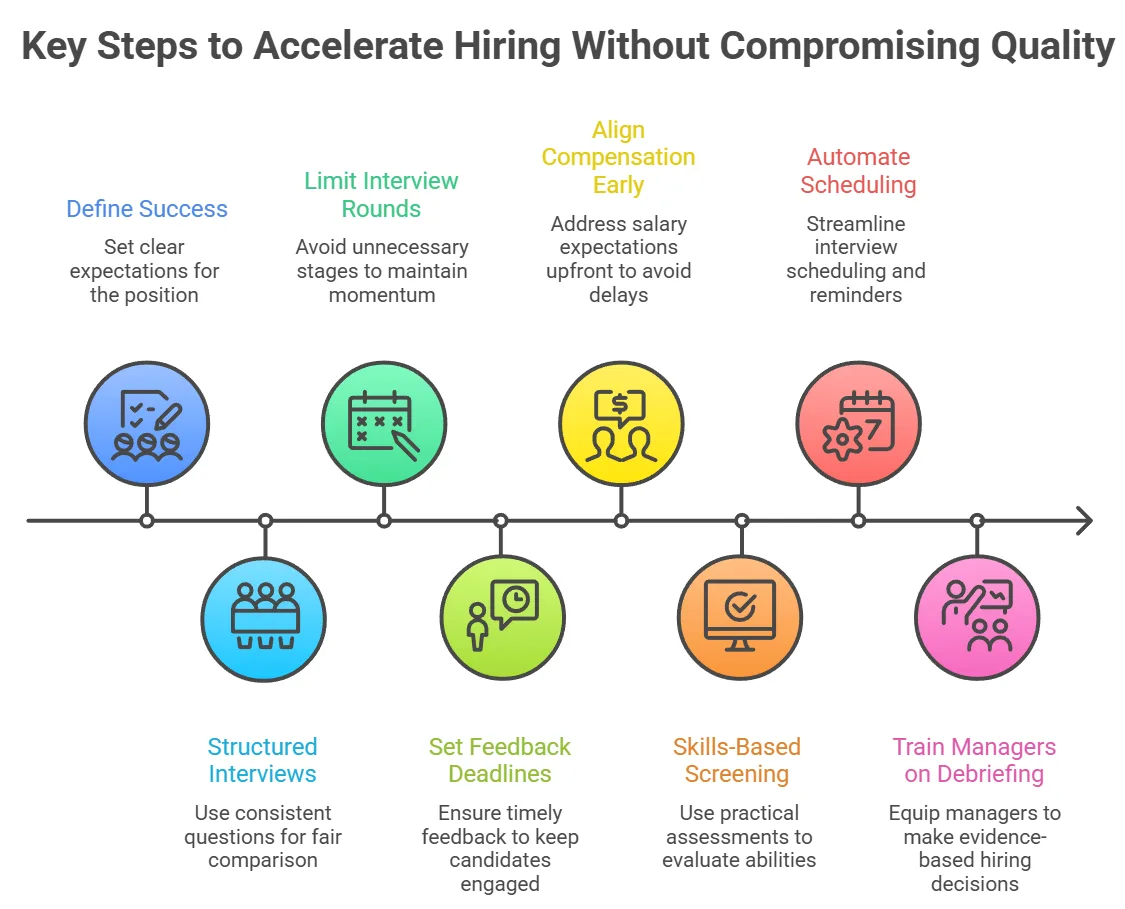
A few practical changes make a huge difference:
-
Define success before opening the role: Clear expectations help recruiters and hiring managers evaluate candidates against the same target from day one.
-
Use structured interviews: Consistent questions create better comparison across candidates and reduce emotional decision-making.
-
Limit interview rounds: Extra stages often add fatigue rather than better insight, especially once the team already has enough signal.
-
Set feedback deadlines: Fast feedback keeps momentum alive and prevents strong candidates from disappearing into silence.
-
Align compensation early: Salary confusion late in the process wastes time for everyone involved.
-
Use skills-based screening and work samples: Practical evidence usually reveals more than polished interview answers.
-
Automate scheduling and reminders: Small operational delays quietly stretch hiring timelines.
-
Train hiring managers to debrief with evidence: Specific examples, scoring criteria, and observable behavior create stronger decisions than vague “gut feeling” conversations.
Now let’s flip the question: how can HR raise hiring quality without adding more drag?
How to Improve Quality Without Slowing Hiring Down
Improving hiring quality means building better learning loops around the hiring process.
The team should already know what “good” looks like before interviews begin, then keep improving that definition with real post-hire data.
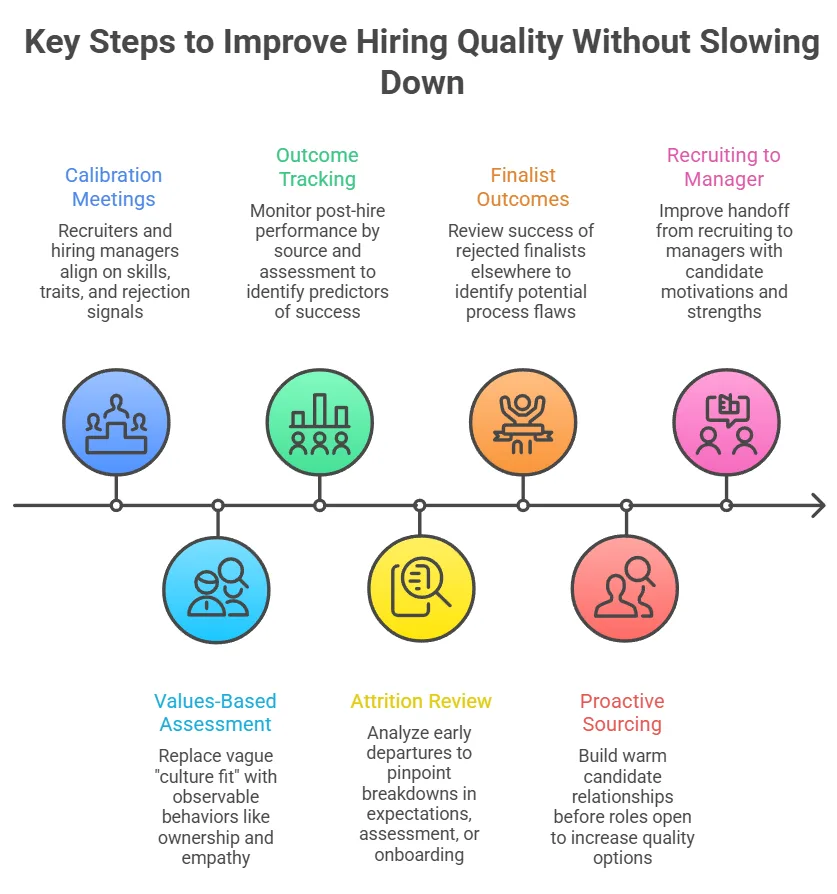
A few moves help HR raise quality while keeping the process smooth:
-
Create role-specific quality definitions: Quality should mean something concrete for each role, such as retention for customer success, delivery reliability for engineering, or forecast accuracy for sales leadership.
-
Track post-hire outcomes by source and assessment method: Look at which channels, tests, and interview formats lead to strong performance after hiring, then invest more in what actually predicts success. Modern HR tools make it easier to track these outcomes and identify patterns that improve future hiring decisions.
-
Run calibration meetings before interviews begin: Recruiters and hiring managers should align on must-have skills, nice-to-have traits, and clear rejection signals before meeting candidates.
-
Replace vague “culture fit” with values-based behaviors: Instead of relying on personal chemistry, define observable behaviors like ownership, candor, customer empathy, or team accountability.
-
Analyze early attrition patterns: When people leave, review where expectations, assessment, manager alignment, or onboarding handoff broke down.
-
Review rejected finalist outcomes when possible: If strong finalists succeed elsewhere, your process may be filtering out valuable profiles too early.
-
Build talent pools before roles open: Warm candidate relationships reduce pressure once a vacancy appears and give the team more quality options. Many recruiters use QR codes to simplify candidate engagement throughout the hiring process.
-
Improve onboarding handoff from recruiting to managers: Hiring quality continues after the offer. Share candidate motivations, expectations, strengths, and risk areas so managers can support ramp-up.
The Mistakes That Damage Hiring Quality and Speed
Before wrapping up, there’s one more piece worth discussing: the habits that weaken both metrics at the same time.
The biggest hiring mistakes usually create confusion, stretch decisions, weaken trust, and leave teams debating symptoms.
|
What goes wrong |
What to do instead |
|
Confusing confidence with competence |
Experienced hiring teams separate presentation skills from actual role evidence. |
|
Falling in love with “unicorn” profiles |
Endless searching for a rare combination of skills often delays hiring long past the point of business value. |
|
Mistaking familiarity for alignment |
Shared backgrounds, similar personalities, or “people like us” energy can distort evaluation quality surprisingly fast. |
|
Treating consensus like a safety net |
Large groups often create slower decisions and weaker accountability because nobody truly owns the final call. |
|
Overreacting to one weak interview moment |
Great candidates sometimes perform unevenly across stages, especially in stressful or overly artificial interview setups. |
|
Designing interviews around trivia instead of real work |
Puzzle-style interviews and theoretical questions often miss how someone actually operates inside a real team. |
|
Confusing activity with hiring progress |
More interviews, more meetings, and more assessments can create the illusion of rigor while adding very little decision value. |
Hire Fast Enough, Choose Well Enough
Quality of hire and speed of hire should never fight for control of the hiring strategy.
They should keep each other honest.
The real skill is knowing which one deserves more weight in each hiring scenario, then building a process that gives teams enough evidence to decide.
Speed gets talent through the door. Quality determines whether that hire was worth opening the door for.
If your hiring process still feels reactive, inconsistent, or overloaded with friction, use this guide to start building a faster, sharper, and more intentional hiring system today.
Author bio: Jake Jorgovan

Jake is the COO of AAG, with vast experience as a creative strategist, industry analyst, and serial entrepreneur who thrives at the crossroads of business and creativity as a musician, visual artist, and creative technologist.


