





Picking a digital business card app for yourself takes five minutes. Picking one for 20, 200 or 2,000 employees is a different purchase. The questions change from "does it look nice?" to "who controls the branding, where do the leads go, what happens when someone leaves, and what will this cost us per seat next year?"
This guide compares the best digital business cards for teams in 2026 from a buyer's point of view: admin controls, CRM sync, directory sync and SSO, lead capture, physical NFC cards and pricing. Every price below was checked on each vendor's public pricing page in October 2026. We make Tapni, a digital business card and lead capture platform that is part of Tapstack, so we have put it on the list. We've kept the comparison to facts you can check yourself, and we say where another tool may suit you better.
If you are buying for yourself rather than a company, our roundup of the best digital business card solutions for individuals is a better place to start.
Quick comparison: team plans at a glance
| Platform | Best for | Team price (public, Oct 2026) | Physical NFC card in the seat price | Native CRM sync | SSO / SCIM |
|---|---|---|---|---|---|
| Tapni | Teams that want cards, CRM sync and NFC hardware in one seat price | $29.90 per user/year (1–10 users), lower per-user prices for larger teams | Yes, a standard NFC card for each user | Yes: HubSpot, Salesforce, Microsoft Dynamics 365, Pipedrive, Zoho, Attio | SSO and SCIM on Enterprise |
| Blinq | Teams that want polished software and are fine with per-lead event fees | $4.99 per user/month billed annually (minimum 5 cards) | Not listed in the plan | Yes | Enterprise |
| HiHello | Marketing teams that care most about email signatures | $5 per user/month billed yearly ($60 per user/year, 5–100 users) | Not listed in the plan | Yes: Salesforce, HubSpot, Microsoft Dynamics | Google and Microsoft SSO on Business; SAML SSO and SCIM on Enterprise |
| Wave Connect | Small teams focused on scanning event badges | $5 per user/month billed annually (minimum 3 users), plus credits for AI lead capture | Not listed in the plan | Yes | Enterprise |
| Popl | Larger event marketing teams buying an enterprise lead capture contract | No public price; quote after a demo | Not listed | Yes | Ask in the demo |
Prices change often, so treat the table as a starting point and confirm the current numbers before you sign.
What a digital business card platform for teams needs
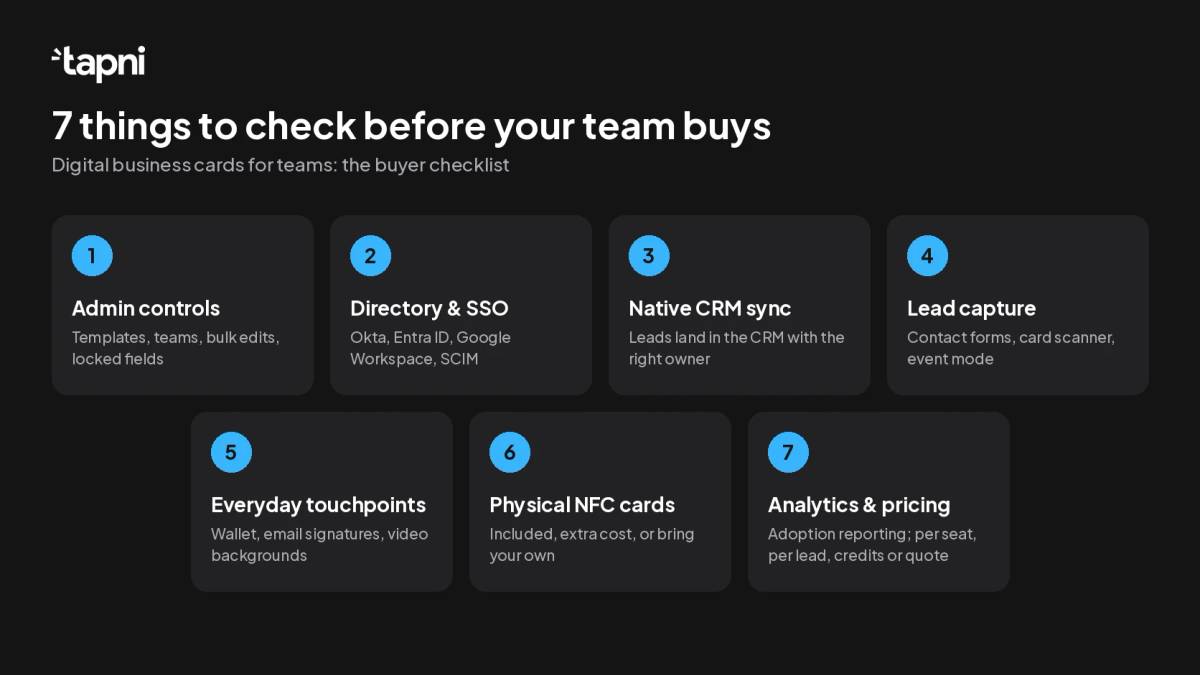
Most consumer card apps can make a good-looking profile. A team platform is judged on what happens around the profile. These are the criteria we used for every tool in this guide.
1. Admin controls and shared templates
One person (often in marketing, sales ops or HR) should be able to create profiles, group people into teams and push one design to everyone. Look for templates that fill in each person's details from variables, so nobody types their name into a shared design, and for bulk actions so you aren't editing 80 profiles one by one. In Tapni, this is the Business Admin Dashboard. The guide to managing users in bulk shows how teams, bulk actions, QR downloads and xlsx profile exports work in practice.
2. Directory sync and single sign-on
Once you pass a few dozen employees, IT will ask whether accounts can be created and removed from your identity provider. Check which directories are supported (Okta, Microsoft Azure/Entra ID, Google Workspace) and which plan includes SSO and SCIM provisioning. With most vendors in this list, SCIM sits in the enterprise tier.
3. CRM sync and lead ownership
For sales-led companies this is the deciding factor. A card that collects contacts but leaves them in an app is only half a solution. Ask which CRMs have native integrations, whether field mapping is included, and whether you can see which employee each lead came from. Lead ownership matters when two reps meet the same buyer at the same trade show.
4. Lead capture tools
Good team platforms capture leads in more than one way: a contact exchange form on the profile, a business card scanner for paper cards, and sometimes badge scanning at events. Check how each is priced. Some vendors include capture in the seat price, others charge per enriched lead or per credit, and those fees add up quickly at a busy event.
5. Wallet passes, email signatures and video calls
Adoption depends on the card being where people already are: in the phone wallet, under every email and on the background of every video call. Check whether signatures are managed centrally and how they are installed in Gmail, Outlook or Apple Mail.
6. Physical NFC cards
Many teams still want something to hand over at a meeting. A tap-to-share NFC card does that without reprinting when a phone number changes. Check whether cards are included in the seat price, sold separately, or left to you to source and program.
7. Analytics and the pricing model
Admins need to see whether the rollout is working, without turning it into surveillance. Then look at how the price behaves as you grow: a flat price per seat, volume tiers, per-lead fees, credits, or a custom quote. The cheapest headline price isn't always the cheapest year.
The best digital business cards for teams in 2026
1. Tapni: cards, CRM sync and NFC hardware in one seat price
Tapni is built for companies that want employees' digital business cards, the physical NFC cards and the leads they collect managed in one place. Tapni is part of Tapstack, alongside MailSign (email signatures), Siteio and T.link, and is run by Tapni GmbH in Vienna, Austria.
Admin controls. Admins create profiles, send logins, organise people into teams and assign templates and company links per team. Templates use variables such as [name], [email] and [vcardTitle], so each employee's own details fill a shared, on-brand design. When someone leaves, the admin can reassign their NFC card to a new employee instead of buying a new one.
CRM sync and lead ownership. Tapni has native CRM integrations with HubSpot, Salesforce, Microsoft Dynamics 365, Pipedrive, Zoho and Attio, so new contacts can go straight to the CRM your sales team already uses. On the Contacts page, each lead shows which employee it came from, which keeps ownership clear after events.
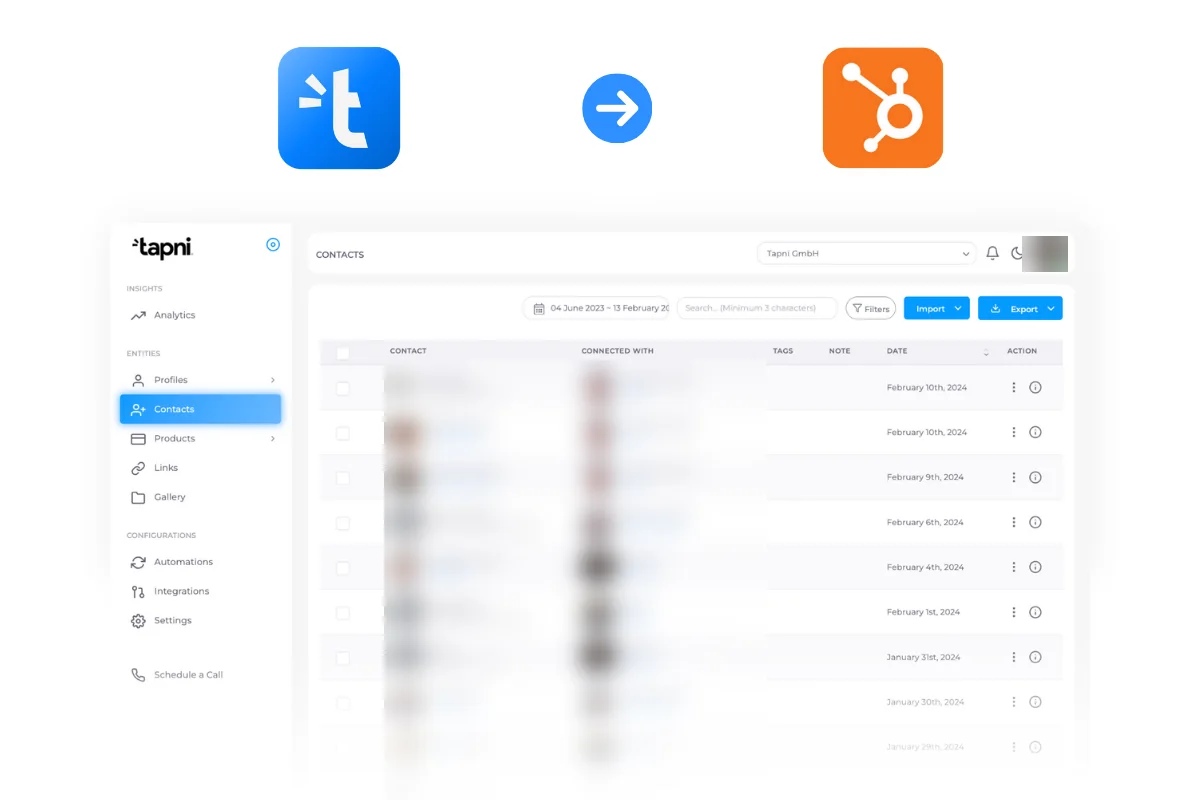
Directory sync and SSO. Directory integrations cover Okta, Google Workspace, Microsoft Azure, Slack and SAML SSO. The Enterprise plan adds SSO and SCIM provisioning, advanced CRM mapping, role-based permissions and Azure Entra integration.
Lead capture and sharing. Employees share by NFC tap, QR code (online or offline), Apple and Google Wallet passes, NameDrop on iOS and virtual backgrounds for video calls. They capture leads with the contact exchange form on their profile and the AI business card scanner. The person receiving the card doesn't need an app.
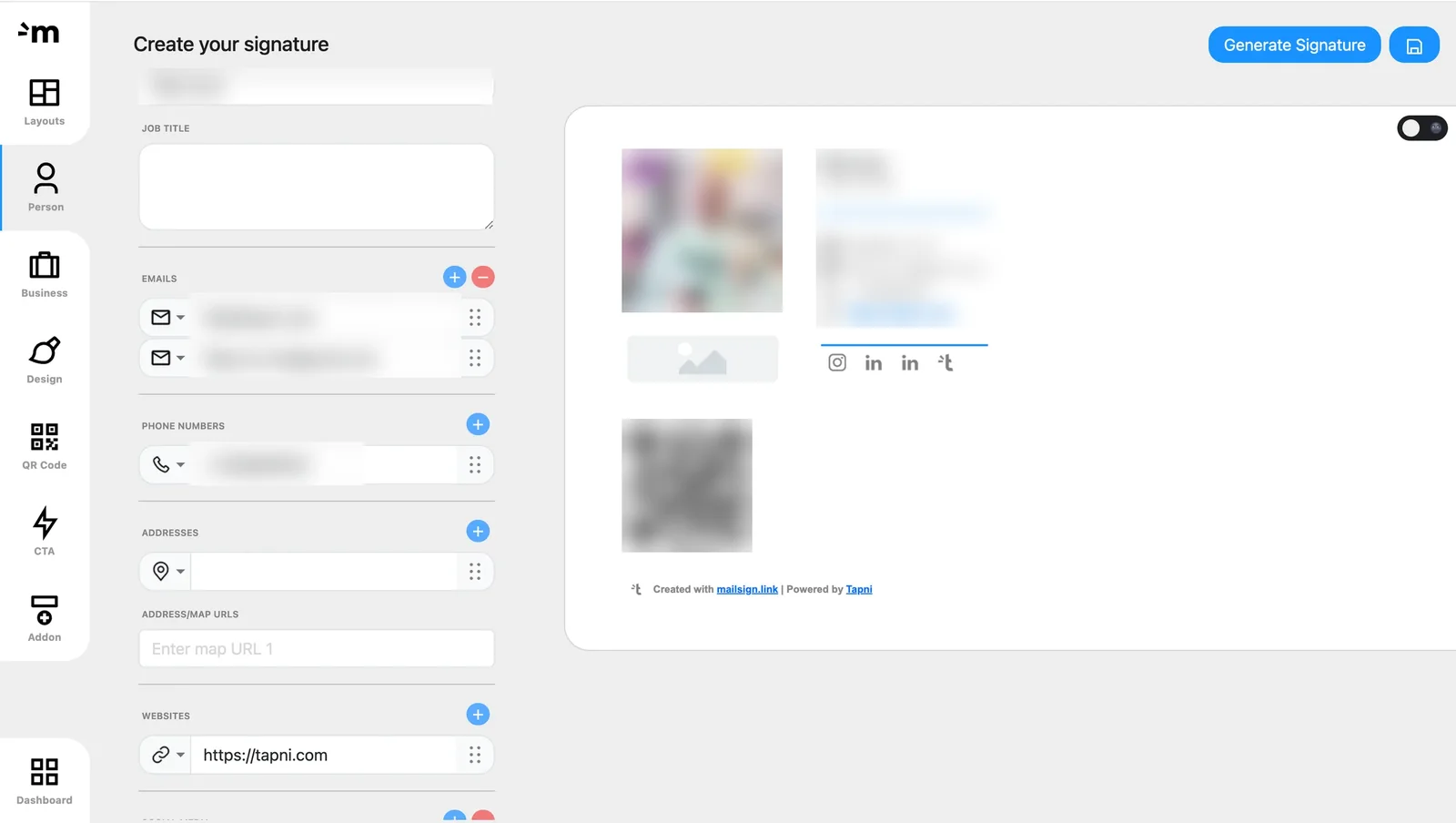
Email signatures. Admins build signature templates in the dashboard (powered by MailSign) and assign them per team, and each member gets the signature with their own details filled in. Each employee then copies the finished signature into Gmail, Apple Mail or another email client. The email signature guide walks through the setup.
Analytics. See your most active employees and each person's profile views by NFC tap, QR scan and link, with date filters and CSV/XLSX/PDF export.
Pricing. On the Tapni pricing page (October 2026), Tapni Business is $29.90 per user per year for 1–10 users, $23.92 for 11–30 users and $17.94 for 31–50 users, billed yearly. Each user gets a free standard NFC card and Tapni Pro. Teams of 50+ get a custom offer.
Good to know. SSO and SCIM provisioning are on the Enterprise plan, not on Business. Email signatures are installed by each employee (copy and paste) rather than pushed to mail servers.
2. Blinq: polished team software with per-lead event pricing
Blinq Business costs $4.99 per user per month billed annually, or $6.99 billed monthly. It is billed per card, with a minimum of five cards. The plan includes digital cards for the whole team, admin-controlled email signatures, custom card templates with field locking, automated card provisioning, native CRM integrations and an AI notetaker.
The detail to model is event lead capture: Blinq lists $9.99 per lead captured and enriched, billed monthly on top of the seat price. Enforced SSO and SCIM provisioning are in the custom-priced Enterprise plan. The plan page does not list a physical NFC card. Our Tapni vs Blinq page compares the two side by side.
Choose it if you want a mature card and signature product and expect only a modest number of enriched event leads each month.
3. HiHello: strongest on email signature management
HiHello Business is $5 per user per month billed yearly ($60 per user per year), or $6 billed monthly, for teams of 5 to 100 users. HiHello says the per-user price drops at 26 and 51 users. Business includes 10 card and 10 signature templates, signatures deployed to Gmail and Outlook, lead capture forms, 50 paper card or badge scans per user each month (pooled across the team), integrations with Salesforce, HubSpot and Microsoft Dynamics, and Google and Microsoft SSO with directory sync.
SAML SSO, SCIM provisioning, a branded subdomain and unlimited scans are in Enterprise, which starts at 100 users with custom pricing. The plan page does not list a physical NFC card, although the Professional plan mentions programming your own. See Tapni vs HiHello for a feature comparison.
Choose it if centrally deployed email signatures and banner campaigns are your main reason for buying.
4. Wave Connect: built around AI event lead capture
Wave Connect Teams is $5 per user per month billed annually, with a minimum of three users. It adds an admin platform, bulk profile editing, custom templates, locked fields, team-wide lead capture, CRM sync and a shared credit pool. AI lead capture runs on credits: Wave lists credits at $2.50 each, with a business card or LinkedIn QR scan costing one credit and an event badge four.
Enforced SSO, SCIM provisioning and hands-on CRM field mapping are in the custom-priced Enterprise plan. The plan page does not list a physical NFC card.
Choose it if your team's main job is scanning badges at trade shows and you're comfortable budgeting for credits.
5. Popl: enterprise event lead capture, priced by quote
Popl now positions itself mainly as an event lead capture platform. It doesn't publish prices. Its pricing page asks you to book a demo for a quote, and its FAQ says plans cover unlimited users, events and leads, with no per-seat or credit fees. Popl lists native integrations with Salesforce, HubSpot, Marketo, Microsoft Dynamics, Zoho and others.
Because there is no public price, you can't compare Popl on cost until you've been through a sales call. See Tapni vs Popl for how the two products differ.
Choose it if you run a large events programme and prefer one negotiated contract over seat-based pricing.
Pricing compared: what a 10-person team pays per year
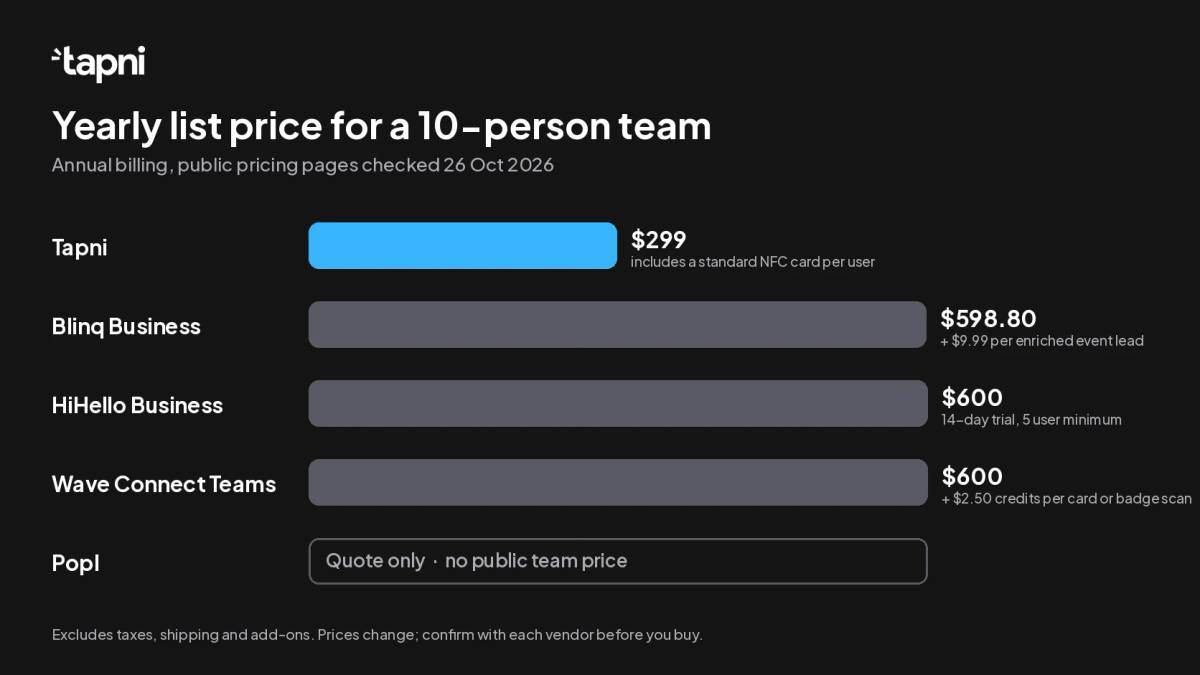
Per-month prices hide the real comparison. Here is the yearly list price for a team of ten on each vendor's self-serve team plan, using the annual billing shown on their pricing pages in October 2026.
| Platform | 10 users, billed yearly | NFC cards for the team | Extra costs to plan for |
|---|---|---|---|
| Tapni Business | $299 (10 × $29.90) | Included (one standard card per user) | Enterprise features such as SCIM are quoted separately |
| Blinq Business | $598.80 (10 × $4.99 × 12) | Not listed | $9.99 per lead captured and enriched |
| HiHello Business | $600 (10 × $60) | Not listed | Scans above the pooled allowance; SAML SSO and SCIM need Enterprise (100+ users) |
| Wave Connect Teams | $600 (10 × $5 × 12) | Not listed | AI lead capture credits ($2.50 each) |
| Popl | Quote only | Not listed | Depends on the contract |
Taxes, shipping and custom card designs aren't included. If your team captures a lot of event leads, add your expected per-lead or credit spend before you compare. That line often decides the total.
How to choose: match the platform to your team
- Sales teams that live in a CRM. Prioritise native CRM sync, lead ownership and capture that is included in the seat price. Tapni and Blinq both cover native CRM sync. Compare how each prices event leads.
- Marketing and brand teams. Prioritise templates, field locking and email signatures. HiHello's centrally deployed signatures stand out here. Tapni covers signatures through MailSign, which is part of the same Tapstack account.
- Event and trade show teams. Prioritise badge and card scanning, offline mode and per-event reporting, then model the per-lead or credit cost against your event calendar. Wave Connect, Blinq and Popl all lean into this use case.
- IT-led or regulated organisations. Prioritise SSO, SCIM, role-based permissions and where the vendor is based. Expect these features in enterprise tiers across the board. If you prefer a European vendor, Tapni is run by an Austrian company.
- Small teams of under 10 people. Prioritise a simple setup and a low yearly total. Watch for minimum seat counts (five on Blinq and HiHello, three on Wave Connect).
Whichever tool you pick, the rollout matters as much as the purchase. Our seven-step rollout plan for digital business cards covers the pilot, admin setup, onboarding and offboarding.
Questions to ask in every demo
- Which features are in the plan we are quoted, and which are only in the enterprise tier?
- Is there a minimum number of seats, and how is a seat counted (per user, per card or per active profile)?
- Are physical NFC cards included, and what does a replacement or a new hire's card cost?
- Which CRMs have native integrations, and is field mapping included?
- Can we see which employee each lead came from?
- How are event leads priced: included, per lead, or with credits?
- Which directories and SSO providers are supported, and on which plan?
- What happens to an employee's card, profile and contacts when they leave?
- How are email signatures installed and updated across the team?
- What usage reports can admins export?
FAQ
What is the best digital business card for teams?
It depends on what the team needs most. If you want admin controls, native CRM sync and a physical NFC card for each employee in one seat price, Tapni is built for that. If centrally deployed email signatures matter most, look at HiHello. If badge scanning at trade shows is the main job, compare Wave Connect, Blinq and Popl on their per-lead pricing.
How much do digital business cards for teams cost?
Public team plans in October 2026 range from about $30 to $60 per user per year before extras. Tapni Business lists $29.90 per user per year for up to 10 users, including an NFC card. Blinq, HiHello and Wave Connect list about $60 per user per year on annual billing. Popl quotes on request.
Do team plans include physical NFC cards?
Not usually. Of the plans in this guide, only Tapni Business lists a free standard NFC card for each user. Check the others' card pricing separately.
Do the people we meet need an app?
No. With Tapni, the person receiving the card opens it in their phone's browser after an NFC tap or a QR scan, and can save the contact directly.
Can we move cards to new employees when people leave?
With Tapni, yes. Admins can remove a card's assignment and give it to another employee from the dashboard, so the physical card stays in use.
See Tapni for your team
Tapni, part of Tapstack, gives your team branded digital business cards, an NFC card for every employee, lead capture and native CRM sync, all managed from one admin dashboard. See how it works on Tapni for Business, or book a 30-minute demo and we'll walk through a setup for your team.